Flagship dataset
The 2026 USCIS RFE trends and evidentiary standards hub.
Adjudication data across nineteen classifications and five service centers, with the top request triggers for each. Free to cite with attribution under CC BY 4.0 — no form, no gate.
- Classifications
- 19
- Service centers
- 5
- Years covered
- 2021–2026
- Licence
- CC BY 4.0
The headline finding
40%
of employment-based Requests for Evidence cite material that was present in the initial filing and could not be located in the exhibit structure.
Add form-to-exhibit data conflicts at 14% and missing translation certificates at 9%, and roughly two thirds of all requests are assembly failures rather than evidentiary ones. Only about 12% reflect a record that genuinely does not meet the standard.
By classification
Nineteen classifications, with the trigger that drives each.
RFE rate is the share of initial filings drawing a request. Denial after RFE is the share of those that are ultimately denied.
| Classification | Form | RFE rate | Denial after RFE | Median days | Top trigger |
|---|---|---|---|---|---|
| EB-2 National Interest Waiver | I-140 | 28.4% | 21.6% | 187 | Dhanasar Prong 2 — well-positioned evidence describes the field, not the beneficiary |
| EB-1A Extraordinary Ability | I-140 | 28.4% | 26.9% | 214 | Final merits determination not argued separately from the three-criteria threshold |
| O-1A Extraordinary Ability | I-129 | 28.4% | 14.2% | 62 | Criteria evidence submitted without comparative context for the field |
| O-1B Arts / MPTV | I-129 | 26.1% | 12.8% | 58 | Consultation letter that does not address the specific engagement |
| L-1A Manager or Executive | I-129 | 32.6% | 29.4% | 74 | Organisational chart without headcount; duties read as operational |
| L-1B Specialized Knowledge | I-129 | 29.8% | 27.1% | 71 | No comparative analysis against others in the organisation |
| EB-1B Outstanding Researcher | I-140 | 24.7% | 18.3% | 196 | Expert letters exclusively from the beneficiary's own institution |
| EB-1C Multinational Manager | I-140 | 31.2% | 28.6% | 203 | US entity staffing too thin to support the claimed managerial role |
| H-1B Specialty Occupation | I-129 | 14.0% | 11.4% | 68 | Wage level inconsistent with the complexity of the duties described |
| H-1B Cap-Exempt | I-129 | 13.1% | 10.2% | 65 | Affiliation asserted with no written agreement in the record |
| EB-2 PERM | I-140 | 11.3% | 9.7% | 158 | Experience letters short of the months required on the ETA-9089 |
| EB-3 Skilled / Professional | I-140 | 10.6% | 8.9% | 149 | Subcategory selection inconsistent with the certified requirements |
| E-2 Treaty Investor | I-129 | 22.4% | 19.8% | 79 | Source-of-funds chain with an unexplained intermediate account |
| TN USMCA Professional | I-129 | 9.2% | 7.4% | 41 | Duties describing a management role rather than a listed profession |
| I-130 Marriage-Based | I-130 | 18.9% | 12.1% | 241 | Bona fides evidence clustered around the filing date |
| I-751 Removal of Conditions | I-751 | 21.7% | 14.9% | 288 | A conditional-period year with no joint financial record |
| I-485 Adjustment of Status | I-485 | 16.4% | 9.2% | 226 | Medical examination outside its validity window at adjudication |
| VAWA I-360 Self-Petition | I-360 | 19.5% | 13.7% | 312 | Declaration chronology conflicting with supporting record dates |
| U Nonimmigrant Status | I-918 | 15.8% | 11.3% | 334 | Supplement B signed outside the six-month validity window |
2021 → 2026
RFE rate trend
2026 adjudication data
Merit vs. corporate, 2026
Merit-based series combines O-1, EB-1 and EB-2 NIW. The 2021–2023 decline in H-1B requests reflects the withdrawal of the 2017–2019 specialty-occupation enforcement posture; the recent rise is concentrated in wage-level and degree-relatedness requests rather than a return to blanket challenges.
Service center variance
The same petition draws different scrutiny by adjudicating office.
Variance of this size is not noise. Firms filing high volumes in one classification should know which office is reading their work.
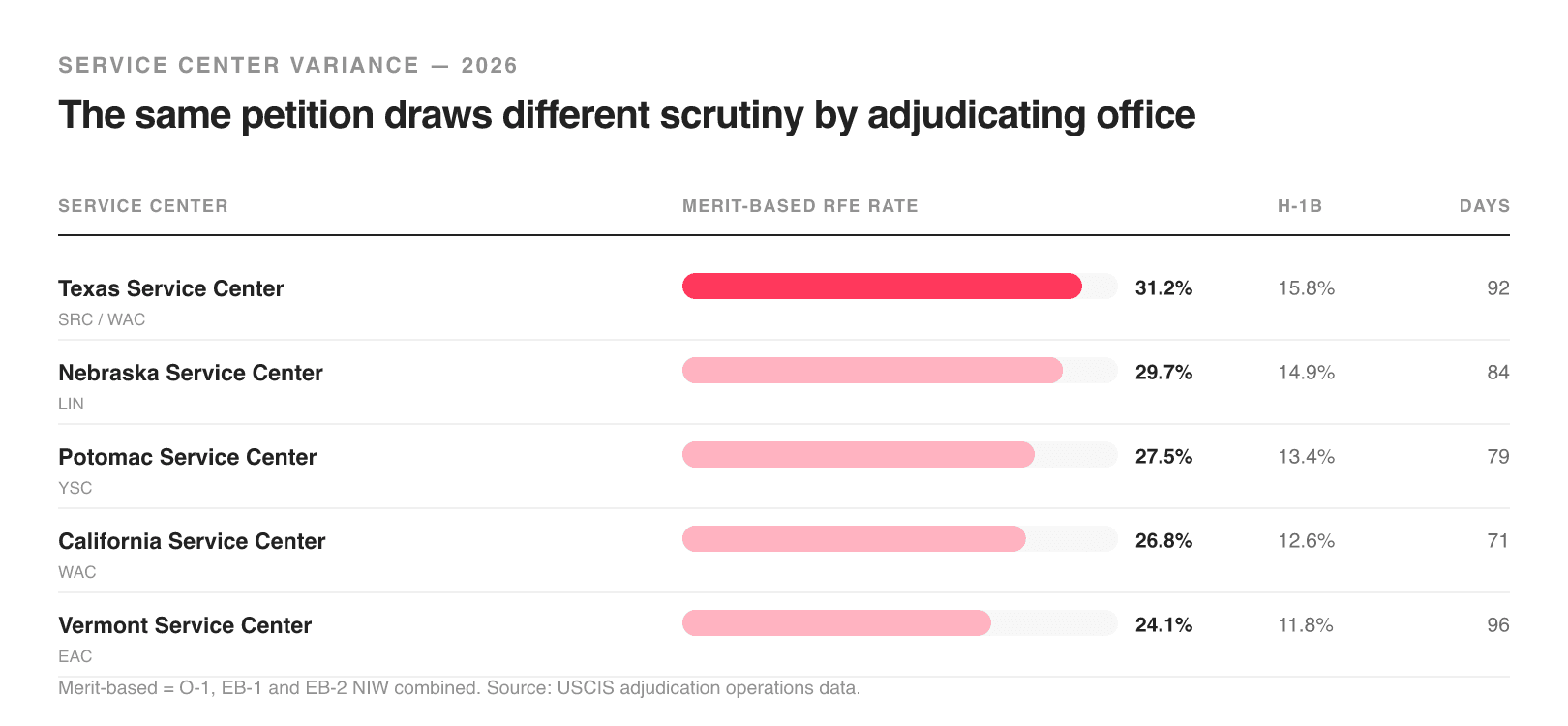
Texas Service Center SRC / WAC
Merit 31.2% · H-1B 15.8% · 92 days
Highest merit-based RFE incidence; heavy scrutiny of expert letter independence.
Nebraska Service Center LIN
Merit 29.7% · H-1B 14.9% · 84 days
Consistent focus on L-1 organisational structure and headcount evidence.
California Service Center WAC
Merit 26.8% · H-1B 12.6% · 71 days
Most O-1 volume; frequent requests for comparative context on criteria.
Vermont Service Center EAC
Merit 24.1% · H-1B 11.8% · 96 days
Humanitarian caseload; requests centre on certification validity windows.
Potomac Service Center YSC
Merit 27.5% · H-1B 13.4% · 79 days
Growing employment-based share; emphasis on ability-to-pay continuity.
Free to cite, with attribution.
Use any figure on this page in briefs, CLE materials, articles or client memoranda. We ask only that you attribute it, so a reader can check the source.
Suggested citation
Docket Build, 2026 USCIS RFE Trends & Evidentiary Standards Hub (2026), https://docketbuild.com/resources/uscis-rfe-database.
Method and limits
- What the figures are
- RFE rate is requests issued as a share of initial filings adjudicated in the period. Denial after RFE is the share of RFE'd petitions ultimately denied. Median days is receipt to first decision, excluding premium processing.
- Where they come from
- USCIS adjudication operations data and form performance reports, cross-read against AILA practice management benchmarks. Trigger categories are coded from published AAO decisions and from request language recorded by customer firms.
- What we do not do
- Customer filing data is never pooled into this dataset. Nothing here is derived from any firm's matters, and no customer outcome contributes to a published figure.
- Known limits
- Service center assignment shifts with workload, so single-quarter comparisons are unstable — the figures here are trailing four quarters. Trigger coding involves judgement, and the categories overlap at the edges.
Sources
- USCIS Adjudication Operations Data & Form Performance Reports
- American Immigration Lawyers Association (AILA) Law Practice Management Benchmarks
- AAO precedent decisions — Matter of Dhanasar, Kazarian v. USCIS, Matter of Chawathe
- USCIS Policy Manual, Volumes 2, 6 and 8
Free audit
See where your own exhibit index is exposed.
Send a draft index and a legal specialist returns a written report on indexing gaps, missing translation certificates and citation vulnerabilities. Two business days, no card.
14-day free production trial · no card · real matters · no watermark
Software for licensed attorneys. Not legal advice.