Assemble RFE-resistant immigration packets in minutes, not days.
Docket Build classifies client documents, maps evidence to USCIS statutory prongs, Bates-stamps exhibits, and drafts structured cover letters with verified citations.
14-day free production trial · no card · ABA Model Rule 1.6 aligned · integrates with Docketwise & Clio
Ramírez — EB-2 NIW exhibit binder
340 pp · DOE-NIW-0001 → DOE-NIW-0340 · rev 4
Tier one — exhibit index
Dhanasar Prong 2
Exhibit 3 — Prong 2 — Well positioned to advance
26 I&N Dec. 884, 890 · DOE-NIW-0122 → 0268
- 3.1 Decl. of Dr. E. Moreau (ETH Zürich)pp. 122–137
- 3.2 Decl. of Dr. A. Whitfield (NREL)pp. 138–152
- 3.3 Decl. of Prof. R. Sato (Tohoku Univ.)pp. 153–166
- 3.4 Adoption evidence — 3 national labspp. 167–214
- 3.5 Peer review record, 4 journalspp. 215–268
Exhibit 3.3 — Japanese-language annex at pp. 161–166 has no translator competence certificate (8 CFR 103.2(b)(3)). Held from the compiled binder.
Compatible with the immigration practice stack firms already run — Docketwise, Clio, MyCase, INSZoom and the storage behind them.
 Docketwise
 Clio Manage
 MyCase
 CampLegal
 INSZoom
 Filevine
 LawLogix Edge
 Smokeball
 PracticePanther
 Google Drive
 Dropbox
 BoxDocketwiseClio ManageMyCaseCampLegalINSZoomFilevineLawLogix EdgeSmokeballPracticePantherGoogle DriveDropboxBox
The flat-fee trap
You charged a flat fee. Your paralegal just spent 16 hours formatting PDFs.
Immigration attorneys do not lose money on legal strategy. They lose it on document friction. When client files arrive as IMG_4821.pdf or as 80-page un-indexed scans, staff spend days on mechanical assembly instead of high-value legal work. One missing translation certificate or one un-indexed exhibit triggers an RFE that wipes out the entire margin on the case.
- 12–20 hrs
Assembling one complex merit petition
Renaming files, building the exhibit index, Bates stamping and drafting the cover letter for an O-1, EB-1 or NIW filing.
- 28.4%
Initial RFE rate on O-1 and EB-2 NIW filings
USCIS employment-based adjudication data. L-1A runs higher still, at 32.6%.
- 8–15 hrs
Unbillable staff time to answer one RFE
Under a flat-fee retainer that revenue was collected months earlier. The response is free work.

Assembly hours per petition
Where the hours go, and where they stop going
- EB-1A22 hrs→55 min
- EB-2 NIW18 hrs→45 min
- O-1A16 hrs→40 min
- L-1A12 hrs→30 min
- H-1B8 hrs→22 min
Bar length is total manual assembly time. The coloured segment is what still needs a person. Manual baselines from AILA law practice management benchmarks; Docket Build figures measured across design-partner firms.
40%
of employment-based RFEs cite evidence that was in the original filing — improperly indexed, or obscured in a disorganised exhibit structure.
See the 2026 USCIS RFE trends hub- 400,000+
- Employment-based petitions adjudicated annually
- 15–20 min
- An adjudicator's review of an initial filing
- 85%
- Of boutique firms bill merit petitions flat-fee
- 3×
- Faster turnaround with structured indexing
USCIS Form Performance Reports
If they cannot find it, they request it
$3,000–$9,000 per case
Measured across design-partner firms
How it works
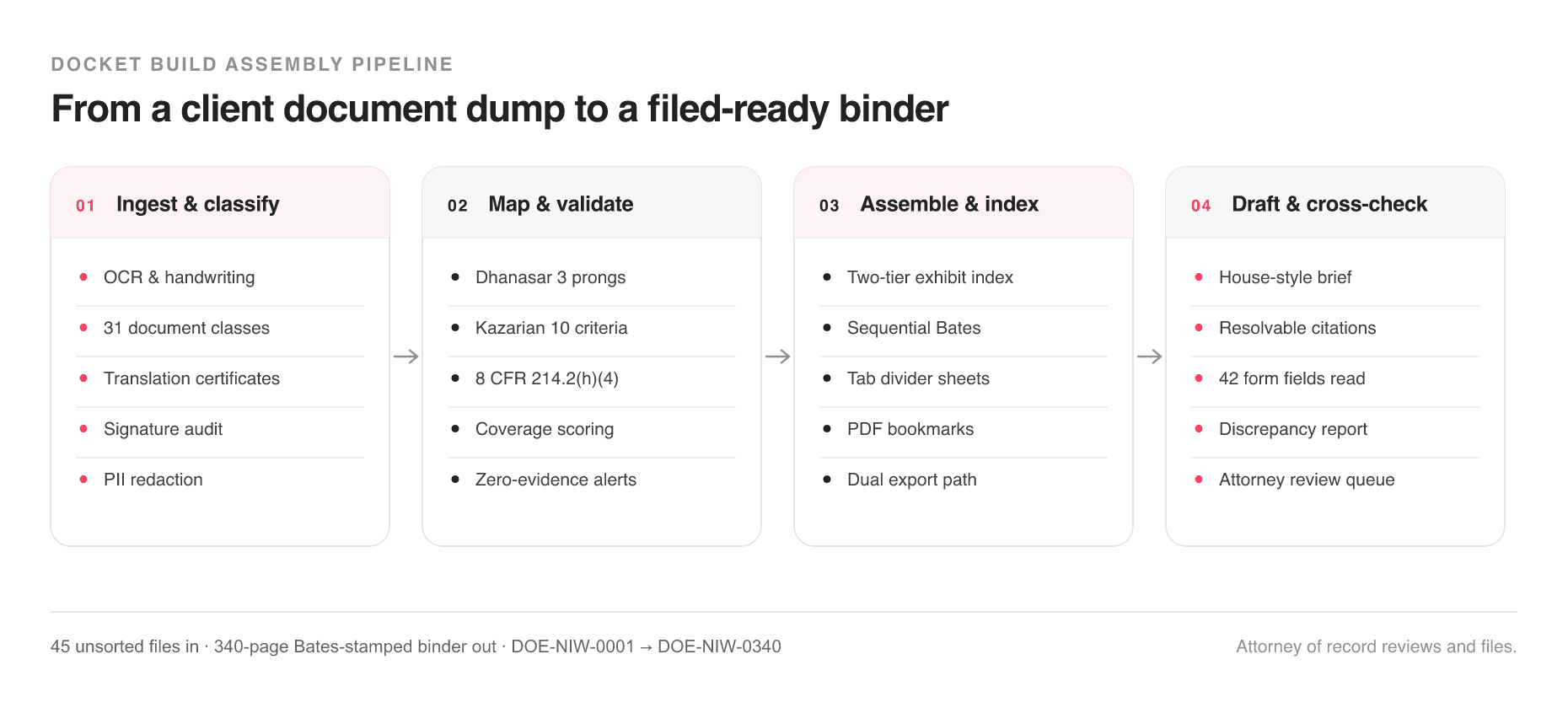
Four stages between a client's folder and a filed-ready binder.
See the full product →Nothing here requires legal judgement — which is precisely the argument for taking it off your paralegal's desk.
- 01
Drop in client files
Upload the folder exactly as the client sent it — phone scans, diplomas, pay stubs, reference letters, Scholar exports, IMG_4821.pdf and all.
45 files · 312 MB · 6 formats
- 02
Auto-classify & map
Docket Build names and categorises every document, checks translations and signatures, then aligns each exhibit to the statutory prong it supports.
31 classes · 9 criteria packs
- 03
Assemble & Bates stamp
A two-tier exhibit index, sequential Bates numbers, tab covers, redacted PII and live PDF bookmarks — generated as one compiled binder.
DOE-NIW-0001 → 0340
- 04
Draft & cross-check
A cover letter in your house style citing exact page ranges, plus a discrepancy report against every draft form in the matter.
12 citations · 3 flags
The strongest argument
Why USCIS adjudicators issue avoidable RFEs.
Two filings. The same evidence. The difference is entirely in whether an adjudicator can find it inside a twenty-minute review.
Disorganised filing
300 loose PDF pages. Filenames like scan0044.pdf. A flat exhibit list typed in Word with starting pages only. Criterion mapping lives in the cover letter — and in the paralegal's memory.
Adjudicator, request for evidence
“Petitioner failed to establish extraordinary ability under 8 CFR 204.5(h)(3)(iv). The evidence submitted is unindexed and the record does not identify which documents correspond to this criterion.”
- 8–15 unbillable hours to respond
- Matter extends 2–4 months
- Displaces one new petition of capacity
Docket Build filing
A two-tier exhibit index with explicit prong mapping. Continuous Bates numbering. Every assertion in the cover letter resolves to a page range that genuinely contains the evidence.
Index entry as filed
Exhibit 4.2 — Peer review records, Nature Materials & IEEE TPAMI, 2022–2025
Pages 84–112 · DOE-EB1-0084 → 0112
Substantiating 8 CFR 204.5(h)(3)(iv) — judging the work of others
- Adjudicator locates the evidence in seconds
- Criterion coverage visible before filing
- Reorder an exhibit — every citation renumbers
2026 adjudication data
Initial-filing RFE rate by classification
Free RFE vulnerability audit
Upload a draft exhibit index. Get a written report on where it is exposed.
We evaluate the index against recent AAO precedent and the USCIS Policy Manual, and flag missing translation certificates, unindexed evidentiary gaps and citation vulnerabilities. No obligation, no card.
The platform
Six engines, one assembly line.
Product overview →Document classifier
OCR for scans, diplomas and stamped visas. Auto-categorisation, translation-certificate gaps, signature audit and PII redaction.
- Passport & I-94
- Diploma
- Transcript
- Expert declaration
- Citation report
- LCA
- Pay stub
- Marriage certificate
- +23 more
Evidentiary mapper
Every exhibit aligned to a statutory prong or regulatory criterion, with an alert for any criterion carrying zero evidence.
Packet assembler
Two-tier index, sequential Bates numbering, tab dividers, live bookmarks and dual export for e-filing or physical mail.
Cover letter drafter
A structured brief in your firm's house style, citing exact exhibit page ranges that resolve against the assembled binder.
Form consistency check
Cross-reads I-129, I-140, I-485, ETA-9089 and G-28 against the exhibits and flags every name, wage, SOC and date mismatch.
Practice analytics
Assembly hours per category, paralegal turnaround, RFE rate by service center, and true margin on every flat fee.
- 47 min
- median assembly
- 7.2%
- blended RFE rate
- 5
- service centers
Evidentiary mapper
Every exhibit answers to a statutory criterion.
Docket Build ships pre-configured criteria packs for the classifications boutique firms actually file. Switch petition type and the whole evidentiary frame changes — prongs, citations, coverage scoring and the alerts for any criterion carrying zero evidence.
- Matter of Dhanasar — three prongs for EB-2 NIW
- Kazarian two-step — ten criteria plus final merits for EB-1A and O-1A
- 8 CFR 214.2(h)(4)(iii)(A) — H-1B specialty occupation
- L-1A/B relationship, year abroad and capacity elements
- Bona fide marital evidence for I-130 and I-485
Criteria pack
Matter of Dhanasar, 26 I&N Dec. 884 (AAO 2016)
All three prongs must be independently satisfied
Prong 1 — Substantial merit & national importance
Dhanasar at 889 · 5 exhibits · pp. 35–121
Substantiated
Prong 2 — Well positioned to advance the endeavour
Dhanasar at 890 · 5 exhibits · pp. 122–268
Substantiated
Prong 3 — Beneficial to waive the job offer
Dhanasar at 890–91 · 3 exhibits · pp. 269–312
Substantiated
Every criterion carries mapped evidence
By practice shape
What changes depends on how your firm is built.
For boutique law firms
Standardise filing quality across every paralegal, protect flat-fee margin, and stop losing evenings to H-1B cap season.
+40% petition volume, same headcount
Read the segment briefFor solo practitioners
A virtual senior paralegal. Double your active caseload without putting a full-time salary on the books.
2.1× monthly petitions, $0 payroll added
Read the segment briefFor contract paralegals
White-label delivery with per-firm Bates prefixes, cover pages and index conventions held as configuration.
3.0× delivered petitions per drafter
Read the segment briefCustomer story

Westbrook & Mireles LLP
Austin, Texas · 6 attorneys
“We were turning away NIW work because assembly capacity, not legal capacity, was the ceiling. That ceiling is gone. My paralegals spend their time on evidence quality now instead of renaming files.”
Dana Westbrook · Managing Partner
Read the full case study- 45 min
- Assembly time per NIW
- +40%
- Monthly petition volume
- 9.1%
- Initial-filing RFE rate
from a 15-hour baseline
with the same headcount
against a 28.4% category benchmark
Trust
Immigration files are the most sensitive documents your firm holds.
Model Rule 1.6(c) requires reasonable efforts to prevent unauthorised disclosure, and Rule 5.3 extends that duty to vendors. We built to that standard and put it in the contract.
Read the security posture- SOC 2 Type II certified
- Security, availability and confidentiality, including the zero-training control.
- Zero model training
- Client files, work product and templates excluded contractually — not by policy page.
- AES-256 and TLS 1.3
- Encrypted at rest and in transit, in ISO 27001 data centres, US or India residency.
- ABA Rule 1.6 and 5.3 aligned
- Matter-scoped access, role permissions and a full audit log you can export.
Integrations
Fits the stack your practice already runs.
All 12 connectors →Matter details and client documents flow in. The finished binder, index and cover letter go straight back to the matter file. Setup is OAuth and under ten minutes.
Docketwise
Immigration case management
~8 min setup
Clio Manage
Legal practice management
~7 min setup
MyCase
Legal practice management
~6 min setup
CampLegal
Immigration case management
~10 min setup
INSZoom
Enterprise immigration
~14 min setup
Filevine
Legal practice management
~12 min setup
LawLogix Edge
Enterprise immigration
~12 min setup
Smokeball
Legal practice management
~9 min setup


Questions
The six we are asked most.
Still deciding? A 20-minute demo on one of your own redacted matters answers more than any page can.
Book a demoNo — and that is deliberate. Docket Build drafts the structural spine of a cover letter: the statement of facts, the evidence-to-criterion mapping, and the exhibit citations with exact Bates page ranges. Your petition theory, your characterisation of the beneficiary's contributions and your legal argument remain yours. The attorney of record edits and approves every word before filing.
Start free trial
Stop losing flat-fee profit to manual PDF formatting.
Upload one messy client folder. Get back an audit-ready, Bates-stamped exhibit packet with a two-tier index and a matched cover letter — in about three minutes.
14-day free production trial · no card · real matters · no watermark
Software for licensed attorneys. Not legal advice.