Drafting guide
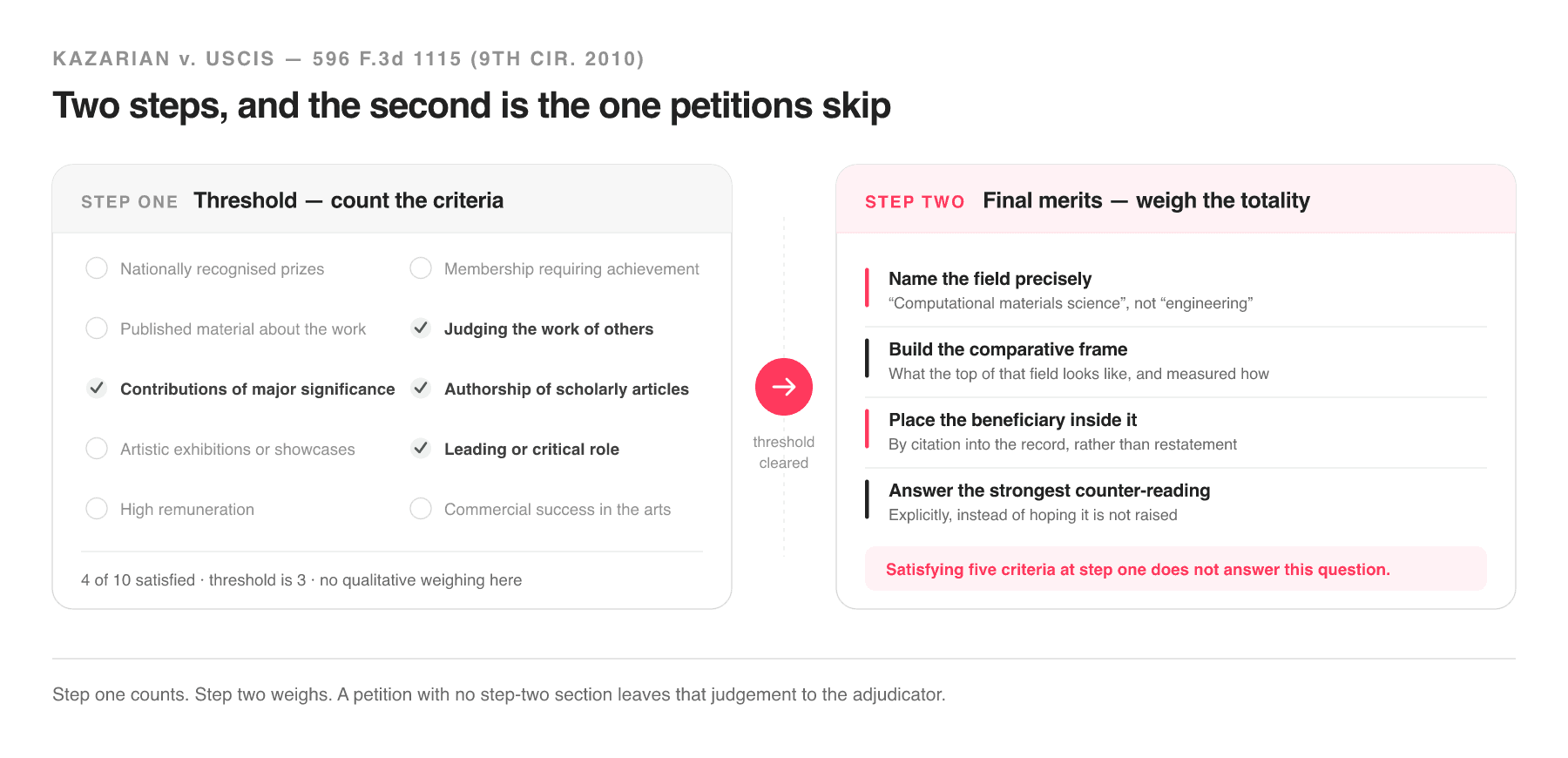
Kazarian: two steps, two different questions.
Meeting three of ten criteria gets you to step two. Most petitions never argue step two at all — and that is the most subjective judgement in the whole adjudication to leave in someone else's hands.
- Citation
- 596 F.3d 1115
- Decided
- 9th Cir. 2010
- Criteria
- 10
- Threshold
- 3 of 10
Threshold — count the criteria
Absent a one-time major internationally recognised award, the record must contain evidence satisfying at least three of the ten regulatory criteria at 8 CFR 204.5(h)(3). At this stage the adjudicator asks only whether the evidence meets the plain language of each criterion. Qualitative weighing is expressly reserved for step two, and USCIS guidance is clear that step one should not be used to import a merits judgement.
- Tab each criterion as its own tier-one exhibit group with its citation.
- State plainly why the evidence meets the criterion's plain language.
- Do not argue significance here — that is step two, and mixing them muddies both.
- Rely on more than three criteria where the record supports it; surplus is protective.
Final merits determination — weigh the totality
The adjudicator then asks whether the record as a whole establishes sustained national or international acclaim and that the beneficiary is among the small percentage at the very top of the field. This is a qualitative judgement on the totality, and satisfying five criteria at step one does not answer it. A petition with no distinct step-two section invites the adjudicator to construct that analysis themselves.
- Open with a comparative frame: what does the top of this field look like, and measured how.
- Place the beneficiary in that frame using evidence already in the record, by citation rather than restatement.
- Address the strongest counter-reading explicitly instead of hoping it is not raised.
- Name the field precisely — 'computational materials science' rather than 'engineering'.
8 CFR 204.5(h)(3)
The ten criteria, and what actually satisfies each.
Evidence types below are the ones that clear the criterion at step one. Whether they carry weight at step two is a separate argument.
Criterion i — Lesser nationally or internationally recognised awards
8 CFR 204.5(h)(3)(i)
- Award certificates
- Award selection criteria and field of competition
- Press coverage of the award
Criterion ii — Membership requiring outstanding achievement
8 CFR 204.5(h)(3)(ii)
- Membership certificates
- Bylaws showing the achievement requirement
- Evidence of who judges admission
Criterion iii — Published material about the beneficiary
8 CFR 204.5(h)(3)(iii)
- Articles with title, date, author and translation
- Circulation or readership evidence for the outlet
Criterion iv — Judging the work of others
8 CFR 204.5(h)(3)(iv)
- Peer review invitations
- Completed review confirmations
- Panel or committee appointment letters
Criterion v — Original contributions of major significance
8 CFR 204.5(h)(3)(v)
- Independent expert letters
- Citation analysis
- Adoption, licensing or commercialisation evidence
Criterion vi — Scholarly articles
8 CFR 204.5(h)(3)(vi)
- Publication list
- Journal impact factors
- Authorship position analysis
Criterion vii — Artistic exhibitions or showcases
8 CFR 204.5(h)(3)(vii)
- Exhibition catalogues
- Venue significance evidence
Criterion viii — Leading or critical role
8 CFR 204.5(h)(3)(viii)
- Organisational charts
- Letters from organisation leadership
- Evidence of the organisation's distinguished reputation
Criterion ix — High remuneration
8 CFR 204.5(h)(3)(ix)
- Compensation records
- Comparative wage surveys for the field and geography
Criterion x — Commercial success in performing arts
8 CFR 204.5(h)(3)(x)
- Box office receipts
- Sales and streaming figures
The missing exhibit
Comparative eminence.
What most step-two arguments lack is a frame. An adjudicator asked whether someone is in the small percentage at the very top of a field needs to know what that top looks like — and that evidence is almost never in the client's document dump. It has to be constructed by the firm.
It is also the single highest-leverage exhibit in an EB-1A packet, because it converts a pile of criteria evidence into a position statement the adjudicator can evaluate.
The long versionComparative eminence evidence that works
Field citation baselines
Median and 90th-percentile citation counts for the subfield at the same career stage, with the source named.
Population of a membership
How many people hold the membership, who judges admission, and against what standard.
Venue selectivity
Acceptance rates for the conferences or journals in question, published by the venue.
Role scarcity
How many practitioners perform the named critical role at organisations of comparable standing.
Award field size
The competition pool for an award, and whether selection is national or institutional.
Remuneration benchmarks
Comparative wage data for the field and geography, from a survey a reader can check.
The assembly consequence
The same exhibit is argued twice. Both citations break together.
Under Kazarian an exhibit is cited once under its criterion and again in final merits. When an expert letter arrives two days before filing and shifts the binder, every citation in both sections is silently wrong. Continuous Bates numbering with citations generated against the assembled range removes the failure mode entirely.
How assembly handles itRelated reading
The Kazarian two-step: documenting a final merits determination
Document checklist
EB-1A — required and conditional evidence
Criteria and mapping
EB-1A criteria, RFE triggers and assembly time
O-1A companion
O-1A eight criteria and the advisory opinion
The NIW framework
Matter of Dhanasar three-prong guide
Start free trial
Stop losing flat-fee profit to manual PDF formatting.
Upload one messy client folder. Get back an audit-ready, Bates-stamped exhibit packet with a two-tier index and a matched cover letter — in about three minutes.
14-day free production trial · no card · real matters · no watermark
Software for licensed attorneys. Not legal advice.