Templates
Six exhibit index formats, built for how adjudicators read.
An index is a finding aid, not a table of contents. These are the structures that let someone with twenty minutes locate the evidence for a specific assertion — usable whether or not you ever use Docket Build.
- Formats
- 6
- Classifications covered
- 20
- Format
- DOCX + PDF
- Cost
- Free
- 01EB-1A · O-1A · EB-1B
Two-tier merit index
Tier one groups by regulatory criterion with its citation; tier two lists each document with a full page range and a one-line statement of what it establishes. Includes a final merits cross-reference block.
Get the templateStructure
- Criterion grouping with 8 CFR citation
- Document row with page range and Bates range
- Proposition line per exhibit
- Final merits cross-reference table
- 02EB-2 NIW
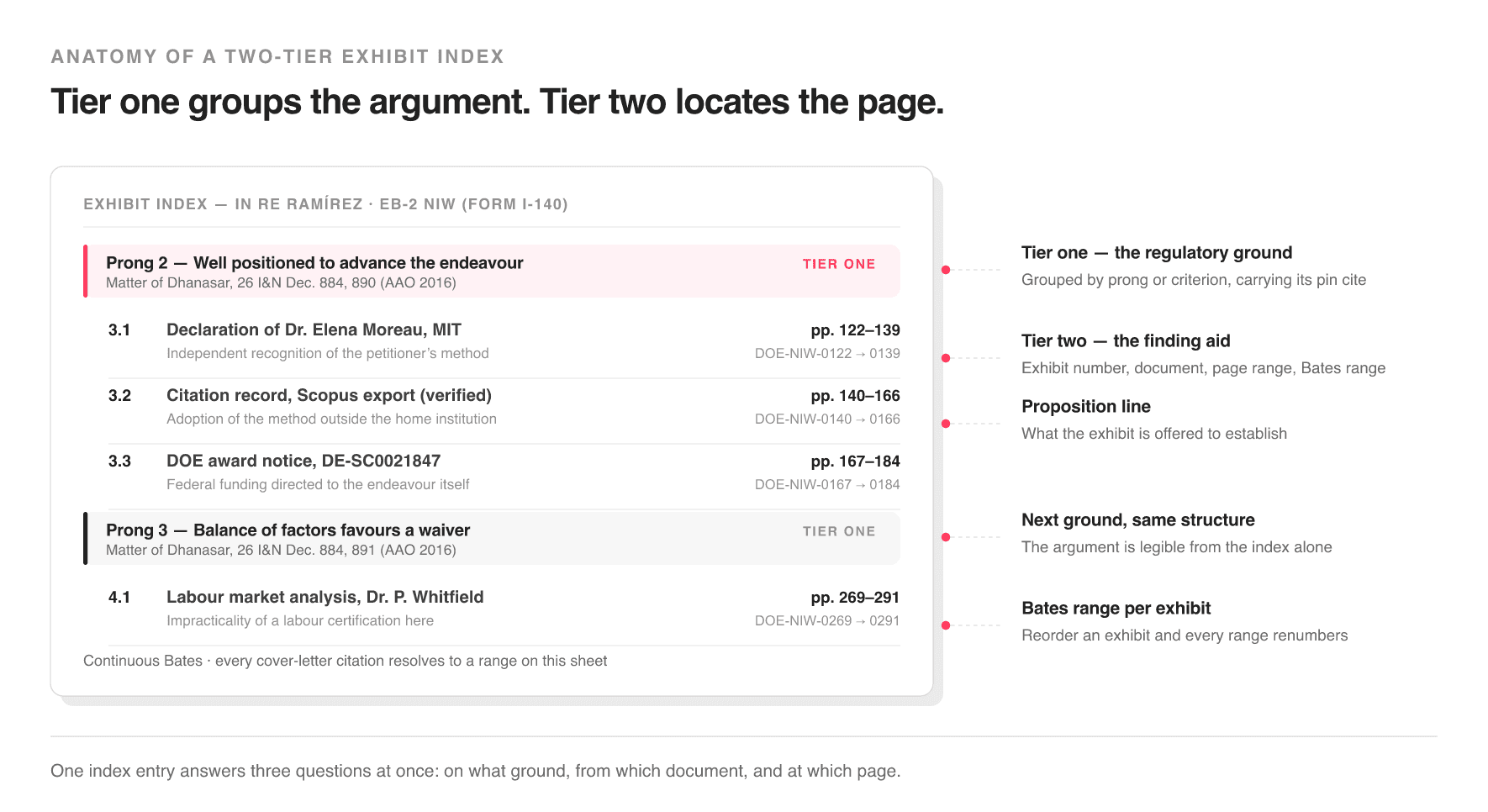
Dhanasar prong index
Three tier-one groups matching the prongs, plus a qualification group. Each prong opens with a coverage summary so a reviewing attorney can see the shape of the argument before reading it.
Get the templateStructure
- Prong grouping with Dhanasar pin cites
- Per-prong coverage summary
- Independent-expert declaration sub-block
- Citation report provenance line
- 03H-1B · L-1A · L-1B · TN
Corporate nonimmigrant index
Organised around petitioner evidence, position evidence, beneficiary qualification and third-party placement. Includes an LCA-to-petition reconciliation sheet as a front-matter exhibit.
Get the templateStructure
- Four-part structure by evidentiary role
- LCA reconciliation front sheet
- Placement chain sub-index
- Org chart and headcount block
- 04I-130 · I-751
Bona fides chronology index
Chronological rather than categorical, so continuity across the relevant period is visible on the index itself. Gaps in the record are legible before an adjudicator finds them.
Get the templateStructure
- Period-based grouping by year and quarter
- Evidence-type column across the chronology
- Commingling summary block
- Affidavit provenance rows
- 05I-589 · VAWA · U visa
Country conditions concordance
Maps each declaration paragraph to the exhibit and page range that corroborates it, so an adjudicator or an immigration judge can move between the narrative and the record without searching.
Get the templateStructure
- Declaration paragraph column
- Corroborating exhibit and page range
- Source publication date column
- Translation certificate status
- 06All classifications
RFE response index
Structured around the request itself: each numbered item in the RFE gets a tier-one group, followed by exactly the evidence that answers it and a reference to where it appeared in the original filing.
Get the templateStructure
- RFE item grouping
- Responsive evidence per item
- Original-filing cross reference
- New evidence flag column
Using them well
Four rules that make an index work.
The format matters less than the discipline. These four hold whichever template you start from, and they are what separates an index that prevents requests from one that merely lists things.
The long version- Give every row a page range
- A starting page is not enough. An adjudicator needs to know where the exhibit ends to know they have read all of it.
- Describe the proposition, not the object
- 'Peer review records' tells them nothing. 'Peer review records for Nature Materials and IEEE TPAMI, 2022–2025, substantiating 8 CFR 204.5(h)(3)(iv)' does their work for them.
- Build from the criteria outward
- Start from the elements you must satisfy and place documents under them. Building from the documents inward hides the criterion with nothing under it.
- Make the gaps visible during drafting
- An index used as a working instrument prevents requests. An index generated at the end as a formality only describes what already happened.
Or skip the template
Have the index generated from the binder itself.
A template still has to be typed and maintained by hand. Docket Build generates the index from the assembled binder, so it cannot drift from the pages it describes.
14-day free production trial · no card · real matters · no watermark
Software for licensed attorneys. Not legal advice.